
Eye Associates Northwest — Adult Strabismus
Clearer, Aligned
Vision Starts Here.
Strabismus is a misalignment of the eyes that can develop or persist into adulthood. Our thorough evaluations look for underlying causes and the treatment options that fit your situation.
- Evaluation for underlying causes, including thyroid disease or stroke
- Options ranging from prism glasses to eye muscle surgery
- Care for both childhood-onset and adult-onset strabismus
Is This Right for You?
Am I a Candidate for Adult Strabismus?
Adult strabismus can develop or persist for a variety of reasons. If any of the following sound familiar, it may be time for an evaluation.
Underlying causes matter: Adult strabismus can stem from thyroid eye disease, brain tumors, head trauma, stroke, Myasthenia Gravis, or complications following other eye surgery, so a thorough workup is often needed.
The Condition
What Is Adult Strabismus?
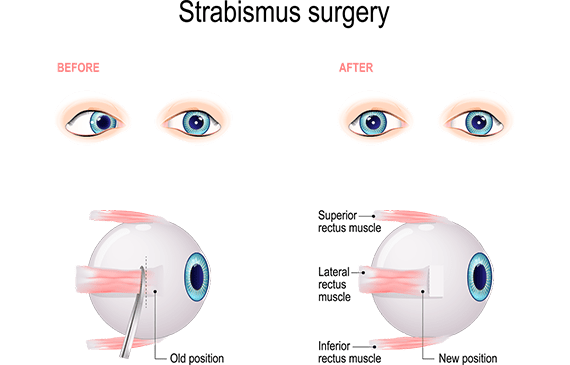
Strabismus is a condition in which the eyes are misaligned and may point in different directions, whether crossing inward, drifting outward, or sitting higher or rotated relative to one another. In adults, it can be idiopathic, a continuation of childhood strabismus, or secondary to conditions such as thyroid eye disease, brain tumors, head trauma, stroke, or Myasthenia Gravis. Because it is often complex, adult strabismus can go under-diagnosed until a patient sees a specialist for a thorough evaluation.
Outpatient
Eye muscle surgery is performed on an outpatient basis
Adjustable
Adjustable suture technique allows fine-tuning of eye position
Any Age
Treats both childhood-onset and adult-onset strabismus
Nonsurgical First
Prism glasses are often tried before surgery is considered
Patient Reviews
Treatment Pathways
Nonsurgical vs. Surgical Treatment
Not every case of adult strabismus requires surgery. Your treatment plan depends on the cause, severity, and stability of your misalignment.
Nonsurgical Management
Prism glasses and monitoring
- Prism glasses, temporary or prescription, to merge double vision
- Appropriate for stable, mild misalignment
- No surgical recovery required
- May not fully resolve larger degrees of misalignment
Often Tried First
Eye Muscle Surgery
Complex and adjustable suture techniques
- Addresses larger or persistent misalignment
- Adjustable suture techniques allow fine-tuning
- Outpatient procedure
- Requires a recovery period and follow-up visits
For Persistent Misalignment
Your evaluation, including sensorimotor testing and any needed imaging or bloodwork, determines which path is appropriate for you.
Step by Step
Your Adult Strabismus Journey
From your first visit to a treatment plan that fits your case.
1
Consultation
- Detailed eye exam and history
- Sensorimotor evaluation and motility testing
- Stereo vision testing
2
Diagnosis
- Review of possible underlying medical causes
- Consideration of brain imaging or bloodwork if indicated
- Discussion of treatment options
3
Treatment
- Prism glasses fitted if appropriate
- Eye muscle surgery scheduled if needed
- Adjustable suture technique used for precise alignment
4
Follow-Up
- Post-treatment alignment checks
- Adjustments to prism prescription as needed
- Long-term monitoring for recurrence
What to Expect
Expected Adult Strabismus Outcomes & Recovery
Outcomes vary by cause and treatment type, and your surgeon will set expectations specific to your case at your evaluation.
What Patients Can Expect in the First 30 Days
- Mild soreness or redness around the eye after surgery is common
- Some swelling or bruising of the eyelid may occur
- Vision may fluctuate slightly while healing
- Follow-up visits scheduled to check alignment
- Most patients resume normal activities within days
Informed Care
Safety & Risk Considerations
Eye muscle surgery is generally safe, though like any surgical procedure it carries risks that your surgeon will review with you beforehand.
Safety Profile
- Performed as an outpatient procedure
- Uses adjustable suture techniques for precise alignment
- Complication rates are low when performed by an experienced strabismus surgeon
Possible Side Effects
- Mild soreness or redness around the eye in the days following surgery
- Temporary swelling or bruising of the eyelid
- Slight double vision or fluctuating alignment while the eyes adjust during healing
How We Minimize Risk
Thorough Pre-Surgical Workup
Sensorimotor evaluation and, when indicated, imaging or bloodwork to rule out underlying causes before recommending surgery.
Adjustable Technique
Adjustable suture methods allow fine-tuning of eye position for a more precise result.
Experienced Evaluation
A specialist familiar with both childhood-onset and adult-onset strabismus guides your treatment plan.
Why Eye Associates Northwest
What Sets Our Strabismus Program Apart
A thorough, specialist-level approach to a condition that is often missed elsewhere.
Comprehensive Evaluation
Sensorimotor, stereo vision, and motility testing beyond a routine eye exam.
Underlying-Cause Focus
We look for medical conditions that may be driving your strabismus, not just the misalignment itself.
Range of Treatment Options
From prism glasses to adjustable eye muscle surgery, matched to your specific case.
Our Team
Meet Our Adult Strabismus Specialist
Specialized evaluation and treatment for eye misalignment in adults.

Find Us
Adult Strabismus in Seattle & the Puget Sound
Adult strabismus consultations are available at our Seattle-area locations.
Coverage & Financing
Cost & Insurance
Costs depend on whether treatment is medically necessary (often covered by medical insurance) or elective.
Insurance Coverage
Adult strabismus evaluation and treatment are frequently billed as a medical condition rather than a routine vision service.
- Comprehensive strabismus evaluation
- Sensorimotor and stereo vision testing
- Review of surgical vs. nonsurgical options
- Billing support through our office
Eye Associates Northwest bills most major medical insurance plans, including Medicare and Medicaid; contact your carrier to confirm your specific benefits before your visit.
Self-Pay Options
If any part of your evaluation or treatment isn’t covered, we keep the payment process simple.
- Pricing reviewed before treatment begins
- Multiple accepted payment methods
- Prompt-pay discount for qualifying patients
- Billing office available for questions
We accept cash, checks, Visa, MasterCard, American Express, and Discover, with a 15% prompt-pay discount for qualifying patients without insurance coverage.
Insurance & Payment Made Simple. We bill most major medical and vision insurance plans, including Medicare and Medicaid. Patients without insurance coverage receive a 15% discount when paying in full the same day. Our billing team can answer questions about your specific coverage before your visit.
locationsCommon Questions
Frequently Asked Questions
Common questions about adult strabismus and what to expect.
Can strabismus develop for the first time as an adult?
Yes. While many cases relate to childhood strabismus, adult-onset strabismus can also result from conditions such as thyroid eye disease, stroke, head trauma, or nerve problems like Myasthenia Gravis.
Do I need surgery to treat strabismus?
Not always. Depending on the cause and severity, treatment may include prism glasses rather than surgery. Your evaluation will help determine the right approach.
Will double vision go away on its own?
It depends on the underlying cause. Because double vision can signal a range of conditions, from mild to serious, it should always be evaluated by a specialist rather than waiting it out.
Do you offer vision therapy for strabismus?
We do not offer vision therapy in our office. Our treatment options include prism glasses and eye muscle surgery, along with any workup needed to identify an underlying cause.
Does childhood-onset strabismus always cause double vision in adulthood?
Not necessarily. Adults with childhood-onset strabismus often don’t experience double vision at all. Instead, they may notice difficulty maintaining direct eye contact, which can affect social situations. This is different from adult-onset strabismus, where double vision is typically the most common symptom.
Ready When You Are
Schedule Your Free Consultation
Most patients see results within 24 hours. Consultations are available at all four locations, online scheduling takes less than two minutes.